| Scope |
To determine the ability of an individual container and its
interior packaging to protect the contents from transportation vibration,
particularly when the container and its contents might exhibit resonant
responses.
|
| Reference |
ASTM-D999, D4169, ASTM D4332 |
| Test Procedure |
- The test specimens should be conditioned as per standard WATER-GDC-T099.
- Fasten the test specimen in its normal transport orientation.
- Mount the accelerometer to either the top or bottom of the test specimen, as
close to the test fixture as possible.
- Monitor the amplitude and frequency data achieved on the test specimen to
ensure that the desired test conditions are produced.
- Adjust the vibration test apparatus to produce the specified constant
acceleration amplitude (zero-to-peak) over the specified range of
frequencies.
- Starting at the lowest frequency, sweep the frequency of the vibration at a
continuous logarithmic rate of 0.5 to 1.0 octaves per minute to the upper
frequency limit and back to the lower limit.
- Repeat this complete cycle twice, recording all the resonant responses of
the test specimen.
- Dwell for the specified length of time at each resonant frequency determined
in step 7 (limited to a maximum of the four most severe resonances), or
until damage to the container is noted, whichever occurs first. Adjust the
frequency of vibration as necessary to maintain resonance.
- If no dwell time is specified, a dwell of 15 minutes is recommended.
- Repeat the procedures of steps 7, 8, and 9 with the container oriented in
those orientations that might be expected to occur in distribution.
- Inspect the container and its contents and record any damage or
deterioration resulting from the test.
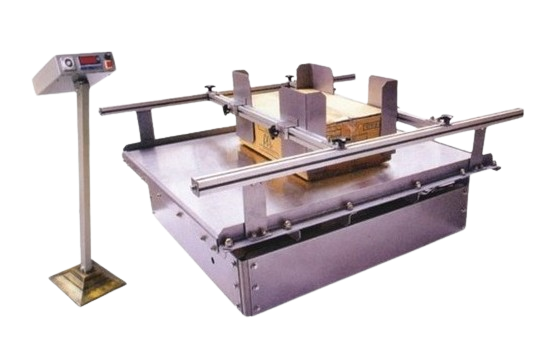
|
| Evaluation |
Inspect the container and its contents and record any damage or
deterioration resulting from the test. |
| Level of Acceptance / Success Criteria |
All Test specimens should pass the test. |
 Wissen BaumEngineering Solutions